While other farmers' cropland is drowning all throughout the midwest this spring, those in our county are just really wet. The Missouri river at the state capital of Jefferson City broke its levies, and a tornado hit the city a couple days ago. We've been lucky in our spot some 70 miles northwest of there. News reports say the river is expected to spill over its banks next at St. Louis and then Kansas City.
This is the Missouri Department of Transportation's map of flooded, closed roads.

s
Green "X" marks our spot
The Blackwater and Lamine rivers are over the roads 3 miles and 7 miles from us, respectively, but so far, we can still get to a town for groceries 20 miles in the other direction. And, the lettuce is doing very well, so there's food. 😊
The garden is wet, but it was predicted that we'd have rain every day this past week, and we got very lucky. Only 4 days of rain. About 5-1/2 inches. And that's in addition to the 4 inches two weeks ago. We won't even talk about the snow melt and rain before that.
There's so much moisture in the ground that it puddles every time it rains now. If you can call this puddling. Maybe pooling is more accurate.
It's finally taking apart the mulch paths.
The plants actually look pretty good considering the very wet, very cool conditions we've had. (Cool no more - it was 90 degrees a couple of days ago.)
The 'Savor' and 'Petit Gris de Rennes' French charentais canteloupes are probably the most sluggish.
Fortunately, I have ten extras that I'm holding in the portable greenhouse that can replace anything I lose. In fact, though, even they don't look all that great.
The 'Golden Muscat' grapes are pulling out of it with the few days of sunshine we
have had.
I wasn't expecting them to fruit this first year, but they have tiny, tiny little bunches forming. These are the flower buds. They may not even develop.
Mind you, I'm supposed to remove those to give the vines more energy to put into getting well established, but I'm going to find it very hard to do that. I may have to leave one bunch.
The one of two blackberry flowers the deer didn't eat is trying to form a berry. Looks like only a few of the individual flowerlets got fertilized.
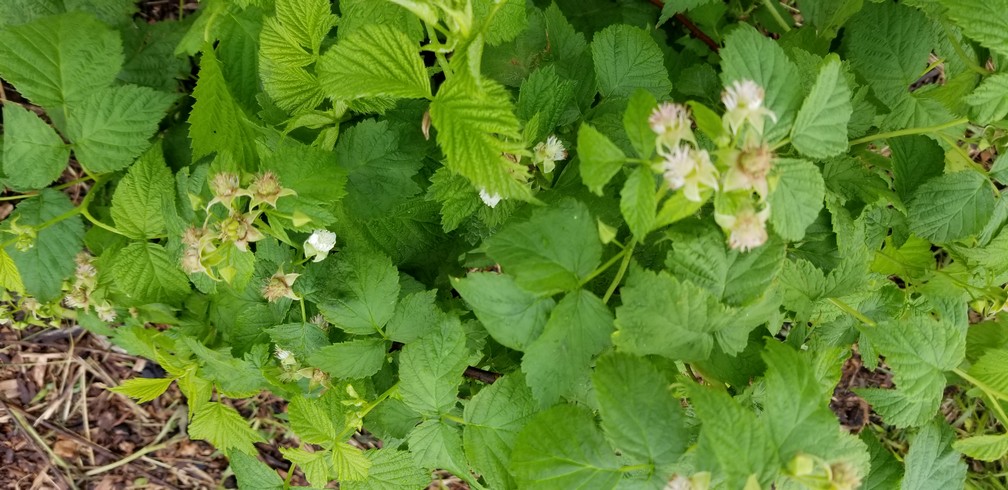
The raspberries may be more promising. At least they have more berries forming. Nobody ate on them.
Wish I could say the same for the peas. At this point, you shouldn't even be able to see any ground, but the rabbits ate them down halfway to the ground a couple weeks ago, and they've not been able to put on much new growth.
I'm so disappointed. But at least the rabbits actually ate what they cut off. It's really aggravating to see the results when they cut something off and decide they don't want it. For instance, the snapdragons:
I've ordered a new repellant that's granular. Maybe that will work better than the liquid spray with all the rain.
Why don't they eat the lettuce? There's plenty and I don't mind losing some.
They haven't gone back for the cabbage they ate off last month.
I guess peas are better. I recently sowed a couple plots of clover (you can see the tiny ones growing up around the cabbage in the picture above if you look closely), and I'm expecting they'll probably have a party in those.
The beets they ate off are trying to recover. At least those that got fairly hidden by the arugula.
This first time for me planting of eggplant is now looking like a bad idea. Some insect has been feasting on it.
It looks to be something of fair size by the frass left behind.
The only thing I can say is maybe they've kept whatever it is from eating other things. On the other hand, they may be attracting insects that wouldn't otherwise be here. I'd prefer the former.
I haven't been able to identify the culprit yet, even after looking at this seemingly comprehensive
eggplant insect ID site. At first, I thought it might be shothole fungus, but a fungus does not pooop.
The cucumbers would appreciate more sunshine, Im sure.
Leaving the vegetables for the rose garden...
Although we've had what I thought was a couple of months' perfect weather conditions for it, there's not been a hint of blackspot on the roses. Last year it was too hot and dry for it, but in previous years, I've battled it with various fungicide applications, including, dneem oil and milk, along with keeping lower leaves clipped off and bushes pruned for good air circulation. It's such an unsightly problem, and a hard one to control, as well as being detrimental to the plant's development due to leaf loss.
This year, I tried something different. I applied a granular
systemic 3-in-1 rose care product from Bayer. I don't remember where I heard of it, but I decided to give it a try and was amazed at what I saw as the results, and thought if it works as well to deter Japanese beetle feeding, I'll be thrilled.
Then I realized that the new roses I put in this year and haven't put any chemicals on yet also don't have any sign of blackspot. So now I don't know what to think.
And then I saw something that ticked me off more than worried me, because I thought it was the result of deer tramping through the rose bed. Two long canes of 'Shazam!' were broken off at the base. But within the next couple of days, the same thing happened to four more bushes, and I didn't see any deer tracks. When I looked closely, I found it was the work of a twig pruner of some variety.
I searched online to find out just who would be doing this and how to get rid of them, and couldn't find anything specific to roses.
I would have expected the systemic product to take care of the job. And, perhaps it has, but only after whoever is causing the damage has fed for a while. No damage has shown up in the past few days, thankfully, because I don't see how a bush could recover if all the canes are chewed off at ground level.
Otherwise, the bed looks nice.
And, wait until you see this new rose 'Razzle Dazzle'. Okay, you don't have to wait.
Dazzling, is it not?
And, here's something odd (at least to me): the 'Pat Austin' rose that just opened, looks like a dahlia:
This is what it looked like all last year:
It looked like a rose.
I'm waiting to see if these annual poppies are white. I planted them from seeds saved from the second generation of a lone white poppy that showed up amongst the 'Blue Hungarian' variety I planted two years ago. It won't be a long wait now, as some of them are in this stage that always looks to me like their tops are wilting. In fact, that's what I did think the first time I saw it. But, no. That's just the strange way they develop.
And this is something new for me that also has a strange developmental habit: 'Apricot Fudge' lily (Lilium longiflorum x asiatic).
That's the pistil shooting out from the forming petals. But it can't be used for fertilization until some anthers show up. Can it? Why do you need your pistil to get so far ahead?
Ah well. Plants are amazing.
And! For the first time in my life, I have seen an oriole. I've actually seen three. At least three. I have seen two distinct males at the feeder. I know they're distinct, because they both showed up at the same time. I've only seen one female, but for all I know, I could have seen more than one. I wouldn't know the difference between them since I haven't seen more than one at the feeder at any one time.
They're so brilliant, but I can't get a better picture, because they take off when I approach. They're pretty awesome in flight.
Enjoy your Memorial Day weekend, but don't try to cross flooded roads, people!
'Razzle Dazzle' hybrid tea rose
Japanese iris