Showing posts with label disease. Show all posts
May 29, 2018 0 comments By: m

Record heat, humidity and leaf spot

Hot.  Hot.  Hot.  Yesterday the weatherman said we set a new record for high temperature on May 29 in this area: 94 degrees.  The previous record was 91.  He didn't say what the humidity was, but judging from othe plants in the mornings, it must be very high indeed.  (One summer when I was attending a concert at my son's college, a visiting professor remarked that he'd never before been anywhere the temperature and the humidity were the same number. Only slightly joking.)

I managed to sow some more lettuce, celery and carrot seed early this morning as long as I had a long shirttail to keep wiping the sweat from my eyes.

The first carrots I planted before the April freeze ('Nantes Scarlet') came up fine, but the next planting on May 2 of 'Kyoto Red' and 'Cosmic Purple' didn't germinate well at all, leaving a big hole in my carrot plot.  I reseeded today with 'Nantes Scarlet', so it will be impossible for me to know which variety I'm about to pull when they mature, but I didn't want to waste more time on the two varieties that didn't come up well.

'Kyoto Red' was a free pack along with one of my orders, and I won't be planting it again even if they send it to me free, because last year I did order it, and what few I harvested were hard as tree wood and inedible.  I figured I'd go ahead and try them again to see if that might have been a fluke, because why on earth would anyone sell a carrot like that?  Maybe that's why they gave them away this year.


The weather conditions we're having are obviously very suitable for whatever leaf spot it is that's attacking pretty much everything that has a broad leaf (zinnias, salvia, toothache plant, roses, cabbage, arugula, beets, tomatoes, melon, cucumber, hyacinth bean, and lettuce that I've noticed so far).  I don't know what's going to become of this attack, as it's not killing anything - yet.  I'm not going to put any treatment on anything but the roses and tomatoes, so we'll see.  I had sprayed the roses with Bayer Advanced Insect, Disease & Mite Control (Tau-fluvalinate +Tebuconazole), and I didn't want to apply more so soon, so I switched back to last year's plan of a spray of 2 parts water to 1 part milk.  That seemed to hold off black spot pretty well, and it can't hurt to ingest it, so I'm trying it out on the tomatoes as well.  Time will tell.  Other than that, there's just too much disease incidence to try to tackle every plant.  If I lose other things, I won't be too upset, but the tomatoes and roses are a different story.

The following pictures are some of the plants showing infection.

Zinna

Salvia

'Savor' Charentais melon

'Marketmore' cucumber

Liriodendron tulipifera - Tulip tree

On some of these plants, there's a definite yellowing of the leaf margins as well.  I don't know if that's a separate condition, but it seems pretty clear to me that it's all related to the steamy weather.

From a distance, things look lush, but if that leaf spot goes brown and kills the tissue, they're going to look very sad.  Perhaps I should say "when" that leaf spot goes brown.  I'm trying not to think about it.

'Sunset' runner bean and 'Marketmore' cucumber

Of course, disease isn't the only thing hitting the garden now.  As expected, bugs are out.  Cucumber beetles are in the roses, and they're going to get hit this evening with Sevin, so sorry.  And somebody fairly large is leaving its evidence of feeding on the zinnias:


If it's grasshoppers, I'm stuck.  It has to be somebody fairly large to be eating that much of the leaves and leaving droppings that size.  I know it's prejudice, but I don't mind knocking off grasshoppers.  However, I  hate to kill caterpillars if I don't know which ones they are, because they may turn into something beautiful like this Silvery Checkerspot butterfly (a member of the Crescent butterfly family):


Alas, I hate having the caterpillars eat up my plants more, so I'll also sprinkle some Dipel on the zinnias this evening. I'm not seeing these guys during the day (although they may be there - it's too hot to stay out long and watch for them), and Dipel breaks down in strong sunlight.  It's an organic formulation (which I also put on my cabbages) that kills only caterpillars, so it doesn't harm bees, and the zinnias are inside the vegetable garden plot where I don't want to put harsh insecticides like Sevin.

The okra isn't showing leaf spot - yet.  'Jing Orange', which is on the outside arc of the following photo, didn't make as good a stand as 'Red Burgundy' to the inside.  I don't have any guesses as to why.


The first planting of arugula has bolted, and I'll let it produce seed for next year.  It's got a pretty little flower.


Two more of the new roses have begun blooming.  'Winter Sun' and 'Dark Desire'.

'Winter Sun' 

'Winter Sun' 


I don't know if it's the extreme heat, or if 'Dark Desire' blooms will always develop rapidly.  I hope the former, because one day is not a good record for a rose bloom.  I'm going to bring one inside to see if it lasts any longer.

'Dark Desire' in the morning

'Dark Desire' in the afternoon

I'm guessing the issue is the heat, because 'Pink Enchantment', which last year had beautiful blooms that lasted several days, did the same thing.

'Pink Enchantment' in the morning

'Pink Enchantment' in the afternoon

'Shazam!' is outstanding again this year; full of blooms that don't seem to be the least affected by the heat:


And so, as Bette Midler sang: From a distance, there is harmony.


And the snapdragons are sweet.  (She didn't sing that.)


May 09, 2018 0 comments By: m

Too cold, too hot: Gardening in Missouri

Well, we had two weeks of spring, so I guess I should be happy.  

I'm not unhappy, just slightly aggravated.  The first two weeks of April were freezing, and the first two weeks of May are turning out to be late July/early August.  I'm going to have to quit looking at the forecast, because every day they show less chance of rain and higher temps - into the low 90s now!  We haven't had any rain since some time in March.  Luckily I have a source of water nearby, but this is not good.

Enough complaining.  I'm now able to harvest lettuce, and about to dig into my first garden salad with baby greens from the 'Rocky Top' lettuce mix, arugula, tatsoi, red-veined sorrel, and home made wheat bread croutons and last year's pickled beets.  


Things are coming along, even though they should be farther, I think.  Too cold at first, now too hot.  Nobody knows what to do.  This is definitely not weather for peas.  I'm sad about that, as they were so good last year I planted twice as many this year.


But, I'm feeling hopeful about the onions.  For the past two years my onion crop has been a failure.  Even when I harvested lots of onions and dried them, they ended up rotting.  I'm thinking that maybe I watered them too much - at least the year it poured rain endlessly, they even rotted in the ground.

I haven't watered them since they emerged from the ground this year, and it hasn't rained, but they seem to be doing okay, so maybe I'm onto something.


The runner beans I planted at the trellis are looking good.  The cucumbers I started early indoors - something I haven't done with cucumbers before - look good, but the seeds I planted directly in the ground failed.  Only one little plant emerged.  Also, the golden zucchini I planted directly didn't come up.  Both packets of seed were from last year's purchases.  Most seeds I get are good for at least two years, and there are always too many cucurbit (melon, pumpkin, squash, and cucumber) seeds in a packet, so I didn't buy new ones this year.  I've made a note not to use old seeds for those plants again.


front row: 'Sunset' runner beans; back row: 'Marketmore' cucumber

Another  issue I've noticed this year is little dead spots on several plants, not all of which are related: melons, cucumbers, tomatoes, tatsoi, sorrel (dock).  The first year I put out my garden, beets and arugula were loaded with the same.  I thought it might be something coming from the nearby wildflower garden, and active in damp, cool weather.  Obviously, that's not the case this year, so I still don't know what it is.  It looks like shothole fungus, a serious pest of fruit trees.  Here it is on the melon seedlings:


My best guess at this point is Cercospera, which attacks in warm humid conditions.  We're not having humid conditions naturally, but I am watering, so that would do it, I think.  I could be wrong.

I won't do anything other than pick off the leaves most affected unless it gets really out of hand, and then I'll either have to apply a fungicide or cry.  I'll be crying in good company of the farmers in the area if we don't get some rain.

Vegetable garden

Left: cut flower garden; right: rose garden


Chives in bloom


UPDATE 5/20:

I'm not seeing that spotting on leaves any more. We've finally gotten some rain. Maybe the change in weather is the reason. I picked off the leaves that were more heavily infested, so hopefully it won't be a problem going forward.
July 23, 2017 0 comments By: m

The Long, Hot Summer

Is this going to be another record year for heat?  Sure seems to be heading there.  And no rain for over two weeks until last night (then 2.5"!).  I had to hand water some things a couple of times in the past week, particularly the new little lettuces and carrots.  And even at that, during the daytime heat, the cucumbers, rhubarb, zucchini and Mexican sunflowers would still go limp.

The limas, which arrange their leaves vertically when it's hot and dry to minimize leaf surface exposure to the sun (aren't they smart!), are producing little pods.


I was losing my paths to overgrown plants, and yesterday cut back the zinnias.  I found my second planting of onions  - the yellow white ones.  They don't look so hot.  Poor things.  They were trying.


The second planting of cabbages that started from little bug-eaten things are coming out of it nicely.  Now let's see who eats them next.


The first cabbages are riddled with bug dining holes.  When I harvested the cabbage heads, I left the outer leaves which included a couple of nodes for side shoots.  Apparently, they produce new heads at those nodes.


I've finally seen a few squash bugs (Anasa tristis) on the zucchini vines.  Nothing like the populations in the past.  I don't know whether that has anything to do with training them upright in a tomato cage or is simply an artifact of this particular year.  Something to pay attention to in the future. 

 
baby squash bug

adult squash bug with  pale gray juvenile above

I did have to take out two dying plants, and I cut off all the older, browing leaves.  Now there's just one plant left.  It actually has green fruits  A stray seed in the 'Golden zucchini' packet?  A mutant?


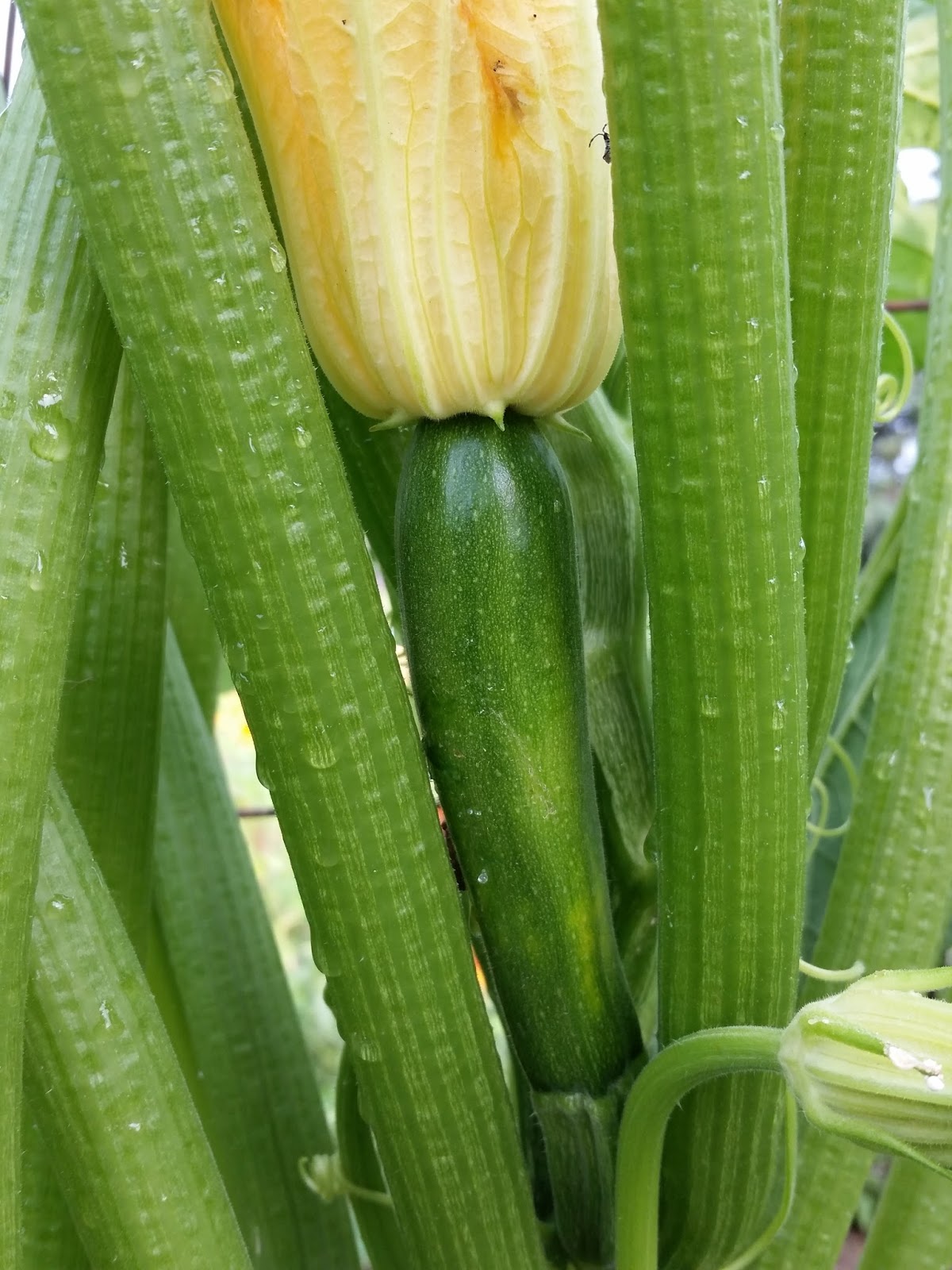
Either variety - green or gold - has these wonderful orange blossoms.which they put in their tacos and soups in the central Mexican area of Michoacan where I stayed for several months a few years ago.


 I'm not getting a lot of fruit from these plants, neither the caged ones nor the ones on the compost pile, which have almost completely wilted out.


The problem with wilting zucchini could be a heavy squash bug infestation, squash vine borer, or a root disease.  I'm not going to go up on the compost heap to find out what's happening there.  The caged plants have only had a smattering of squash bugs, so I don't think that's what's happening.  I didn't see the telltale signs of boring into the base of the plants, although I could just have missed it. When I pulled up two dying plants, one had roots that looked in good shape, and the other had barely any root at all.  What was there looked pretty dead.  I can't tell if that's feeding on the root or disease.


If it's a root fungus, I would expect the other remaining plant to contract it, since they were planted right together.  It may yet happen, but right now, the plant looks good.


Speaking of surprises from seed...Amongst the okra seeds that I saved last year from 'Red Burgundy', there is one plant producing green okra.  Although this could be a mutation, it's more likely that it's a reversion to one of the parent plants of the hybrid 'Red Burgundy'.  

Here's another example of seeds not "coming true" to the plant:  


These plants are both from the same 'Black Pearl' ornamental pepper.  It's quite obvious 'Black Pearl' is a hybrid when you see the results of the offspring.  And, while it's possible one - or both - of these is a reversion to a parent of 'Black Pearl', they could be something else between the two.  Genetics is a mix-up in all of life, but perhaps most readily visible in the plant kingdom.  And isn't it fun?

You know what else is fun?  Gardening in the summer in Missouri.  You get the 90+ degree heat.  And you also get periodic downpours with high winds.


I also lose my mulch paths when this happens.


The tomato that was on a trellis and the caged zucchini that fell over will both be okay, I think.  The ground was so wet that there seemed to be minimal root breakage. I stood them back up, and time will tell whether they survive and thrive - or not.

I also had to stand up two of the Mexican sunflower plants that had grown so large and were blown over.  I staked them, and I expect them to be okay also.  These plants are very tough, and if - no, when - some of the heavier branches break over, they simply put down roots and keep going.


(Update:  The picture above was taken in the early morning when I put these plants upright.  I didn't think to check on them until 1:00pm, and this is how they looked:


Needless to say, that is not good.  I put some cloth over them for shade and have my fingers crossed.

Back to the original post:

When I was up in Des Moines visiting my son's family a couple of months ago, I took along two little Mexican sunflower plants and planted them in their back yard next to the picket fence.  A few days ago my granddaughter texted a picture of them saying they're almost five feet tall and asking me what they are  - their neighbor likes them.  They'll easily be able to share with the neighbor for next year, as these things are prolific bloomers (as you can tell by the picture), and the seeds are as easy to collect and sow the next season as marigold seeds.  In a shaded area, they'll get taller and leggier, of course, but they still perform.  Those in my garden in full sun are about four feet tall and just as wide.

The caged tomatoes weren't damaged by the wind and rain, but they all have such a heavy load of fruit that some of them are getting pinched between stalks and cage wires.  I cut off several that were crowded and crowding other fruit and will let them ripen indoors.  


Some of the ripe harvest to date:

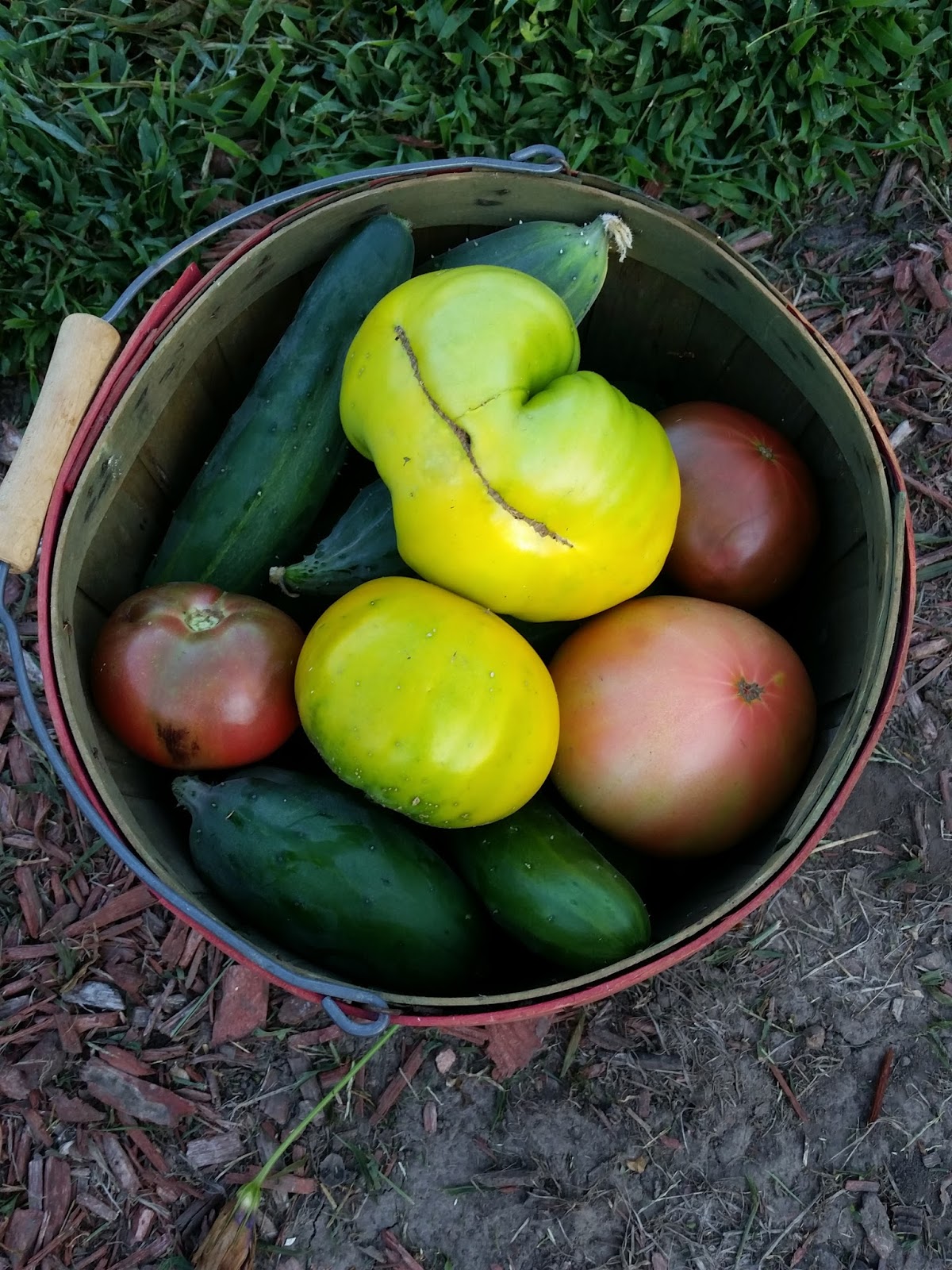
 'Gold Medal' and 'Missouri Pink Love Apple' tomatoes

I was expecting the 'Gold Medal' fruits to be a striped variety.  This particular one was growing all jumbly, and the red seemed to ring  what looked like individual fruits that were subsumed into one large one.  The only other ripe 'Gold Medal' tomato to date did not have this distorted growth and was completely golden skinned with lemon colored flesh.  To be continued.


'Black Beauty' (left and center) and 'Missouri Pink Love Apple' (right) tomatoes; 'Purple Ruffles' basil

I didn't have a spare tomato cage to hang onions for drying this year, so I'm just laying them out to dry.  They're taking over the patio table.


I harvested some 'Shiraz Tall Top' beets yesterday and roasted them in the oven with some fresh garlic I pulled and some potatoes from the compost pile. I put them all in the same clay bean pot I got from the Galveston Island Marshall's some years ago while living there, potatoes on the bottom, in a little coconut oil and salt at 390 degrees for just under an hour.  Yes, they are delicious.


 The Mexican tarragon is in full bloom.  And falling over.


Look at this gorgeous flower that's just beginning on the 'Cardinal' basil.  I purchased the seed just for this.


That creeping orange thyme that doesn't like to be wet is not happy at all.  I hope it can come back from this.


The little head lettuce that I'm trying to get seed from is finally flowering.  They'll turn to little dandelion-like heads, and then I'll take its seed and cut it down.


That whole "shady" end of the garden contained the early spring plantings, and it's looking rather shaggy now, with the second plantings not yet up and going.


Remember this guy early in the spring?  The assassin bug, from the Reduviidae family of insects. This is a juvenile.  He's dining on a Japanese beetle.  Hooray for the assassin!


The picture below is an adult Reduviid hanging out on my okra, which is where lots of Japanese beetles are mating and feeding.
 

This type of assassin is called a wheel bug, and a close up will tell you why.  He's got an upright half-wheel shape protruberance on his back that appears to have little cogs.


The pretty lavender monarda and gray head  (yellow) coneflower that filled the wildflower garden in the spring are all spent, and now the summer-blooming  black eyed Susans (Rudbeckia) and a few  purple coneflower (Echinacea) are in flower.  There's also a little bit of Queen Anne's lace (wild carrot).  The purple coneflower and Queen Anne's lace are intermediate bloomers between the spring and summer wildflowers but continue to bloom all summer, along with the black eyed Susans.


But here's something. Anybody know what it is?  I don't.


It does look rather like these white globe thistles, but the flowers are purple and look to be unfolding.  Also, the leaves are different.

Update:  I went back out and found another plant of these purple flowers.  They don't look a thing like globe thistles when they start opening...more like wild carrot (Queen Anne's lace), and then nothing like that when they're unfurled.  Maybe they're something in the aster family?

Further update:  Ironweed


I love these white globe thistles.  As long as I don't have to get too close.  They look like something that belongs in the desert to me.


UPDATE:  These are not globe thistles, but Eryngium yuccifolium, aka rattlesnake master.  There are only a couple left in the wildflower garden.  The coneflower and monarda have pretty much taken over.  I need to propagate these before there are none.

And speaking of not getting too close, this 'Grand Amore' rose appears to be aptly named (if you're a bit jaded).  


Those are some nasty thorns at the base.  But look at the beautiful flower.


 And, lastly, the Lisianthus are rockin' it.


Well, they were until the rain beat them down last night.  They'll turn their heads toward the sky today, though, and rock on.

Hang in there Missourians, August is on the way.

'Til next time.