July 22, 2021 0 comments By: m

Late July (an excellent chip and cracker brand)

While I'm expecting great things from the melon family this year, a number of other things just didn't do so well.  I can't blame them.  Spring was unseasonably cool, and the early summer was way too wet.

The onions made a poor showing.  I don't think the cool spring  hurt them, but with the deer pruning and the soggy summer soil, they haven't grown very large.  They still taste good, but they're quite small.


The two 'German Johnson' tomato plants I ended up with really had problems with the weather.  They're producing fruits that are a bit smaller than previous years, but the plants are only half as tall, so I'm assuming I'll get maybe half the yields.  And, because I mislabeled my tomato plants this year, I only have two plants.  😢  That's going to severely limit my BLT season.


The plant in a cage is only reaching halfway to the top.


Last year at this time, they reached the tops of the cages, and this is how the fruits looked:


There are no clusters this year.  Last year, they were all growing in clusters.  

I recently planted a row of tatsoi along side my row of  'Calima' bush beans.


You don't see the beans, do you?  That's because rabbits stripped every single one of the leaves last night.  They left the stalks:


The ears of the 'Striped Japonica' ornamental corn that didn't form husks nevertheless are forming a few kernels. 


That kernel near the top looks a little smutty, and while some cultures consider smut a delicacy, I believe I'll pass.

Happily, there are still some flowers doing well enough that I can make a few bouquets.

'Grande Amore' red roses, cactus zinnias, globe amaranth, 
butterfly milkweed and greenery from baptisia and crapemyrtle

While the Japanese beetles are the only insect pests I have to control, they aren't the only insects in the garden.  The striped monarch caterpillars are fattening up on the butterfly milkweed (their only food source).


And I spotted this lone milkweed leaf beetle the other day.


Fancy, eh?

Until next time, stay safe.

Hibiscus - unknown variety

P.S.  Speaking of tomatoes (and flower parts from the previous post), here's a good video from GrowVeg.  All of the GrowVeg videos are excellent, so you might want to subscribe, which you can do from the link at the end of the video, by hovering over the icon image of Ben in the upper left corner of the video, or by clicking the red subscribe button on the web page

July 20, 2021 0 comments By: m

A short(ish) post about flowers


During a recent check on my pumpkin patch, something that had always been hovering around the back of my mind came forward, and I decided to check into why some flowers were producing fruit and others weren't.  My first idea was that some of them were male flowers and others were female.  You knew that, I'm sure. But the stumbling block for me was that they all look alike.  On closer inspection, even though they look alike, they aren't borne on the same type of peduncle (or flower stalk).

Short aside here: I originally typed pedicel instead of peduncle, and in checking to make sure I was using the right term, I found I wasn't technically correct.  A peduncle is the main flower stalk, and a pedicel is the flower stalk of each individual flower on a bloom made up of several smaller individual flowers.  

Okay, back to the pumpkin flower...

The male flowers are all borne on long, thin peduncles:


And the female flowers are borne on short, thick stalks.  The pictures below show the fruits (ovaries) already swelling atop the stubby peduncles:


And then, by happenstance, I noticed what I thought was a strange formation of the sex parts of one of the flowers, maybe a mutant:


Most of the ones I had been noticing were like this:

As it turns out, -- you guessed it -- the first picture is a female flower, and the second is a male.

Nature is amazing.

Once the flowers have served their purpose, the males simply wither up and that's that.  The females, of course (if they got pollinated), fall off and leave a developing fruit behind.  


I should have lots of pumpkins this fall if the weather holds, because a colony of honeybees is having a party in the pumpkin patch.

Some bunny ate most of my plants early on, and I had to replant pumpkins.  I didn't have any more daisy gourd seeds, so I wasn't sure any of those survived.  The vines and flowers look exactly like the pumpkin ones.  And then, I spied this little fruit:


Funny looking thing.  Now I know at least one gourd vine survived.  It should turn out to look like one of these:


That business about male and female flowers doesn't apply to all plants.  If the plant has separately sexed flowers on individual plants, it's called dioecious, from the Greek meaning two houses.  That's probably the rarest arrangement, and is where they tell you that you need both male and female plants if you want flowers - or at least have a male plant within pollinating distance.

If the flowers are separately sexed, but on the same plant, it's called monoecious, or - yes, one house. And that's what plants in the cucurbit family have, which includes pumpkins, squash, zucchini, gourds, melons and cucumbers.

Then, there's another type of flower, which you no doubt have thought of - the "perfect" flower.  It's perfect in this sense meaning both male and female parts exist in the same bloom.  Like this hibiscus:


This is a very common type of arrangement with the anthers (the male pollen-bearing structures) surrounding the pistil (the female receptacle that leads to the ovary, the seed-bearing structure).

The hibiscus plant was the only one in the wildflower garden, and every year it struggled to compete enough to produce one stalk and a couple white flowers hidden amongst all the rudbeckia and monarda surrounding it.  And then when it produced its one or two flowers, the Japanese beetles would destroy them.  I dug it up and moved it to my perennial bed two years ago, and I found the flowers actually open up to these gorgeous pink tinged petals with a deep pink center.  And this year, it looks like this:


This iris, too, is a perfect flower, but it's parts are much more elaborate and not so easily detected.


I'm not going to go into the whole story of the iris structure, but here's a basic article on it if you're interested:


I normally remove all iris stems once the bloom fades, but this year I left one standing while it developed seeds:


I'll plant some out next year to see how long it takes to get a bloom from seed, and what the bloom looks like, considering this iris is a hybrid.

Double stargazers have neither anthers or pistils - no reproductive parts.  So you know they have to be grown from cuttings or clones.  It seems the reproductive parts formed into extra petals.


A benefit is that you don't get orange stains on your nose when you sniff them up close, or on your clothing or white tablecloth when the anthers drop.  They're interesting, and they smell just as nice as normal stargazers, but I rather like the look of the graceful anthers and pistils.

Stargazers' showy reproductive parts include long thin anthers on stalks (called filaments) surrounding a long thin pistil.  Well, technically, the pistil includes the stigma at the top which receives pollen from the anthers, the tubular style, and the ovary at the base.


That's all folks.  Stay cool and get your covid-19 vaccinations to thwart virus mutations that seem to be popping up.  Missouri is doing especially poor in this pandemic.  Put your masks back on in crowds.  And go outside where you don't have to wear one, and check out the flowers in your neighborhood or the wild ones in parks and countrysides. 

Or...do whatever you want...just enjoy it.
For more information on floral reproductive parts:
Botanical Terminology: Flowers, Houses and Sexual Reproduction

July 16, 2021 0 comments By: m

Mid-summer gardening

Thank goodness the roses had no problem with the recent flooding.

'Razzle Dazzle'

'Neptune'

This is the only rabbit I've seen this year.  A shy, and precious, visitor...


It's hard to be annoyed with this little fellow, even though he's (she's?) eating my bean sprouts.

The flowers for cutting were put off by all the rain, but I've managed to get a few anyway.

Cactus zinnias, 'Cherry Brandy' echinacea, rattlesnake master, 
'Mandarin orange' gomphrena, butterfly milkweed, and flase indigo

The Japanese beetles haven't been as plentiful as some years, thank goodness, but when I miss capturing or spraying them for just a day, they do some serious damage.

Fortunately, there have only been a scattering of them on the pumpkin vines and corn, because I can't spray there....

...because scores of honeybees are having a heyday in the flowers.


I can spy several little fruits, and I'm anxious for them to mature, because they're pie pumpkins.  


The ornamental corn is doing some weird things.  (And it's not as ornamental as I was expecting.)


Most of the "ears" are shooting out of the husks.  There's only one that looks like a normal ear of corn on a stalk.


Probably won't be planting this again, but I might try some sweet corn next year.  Might.

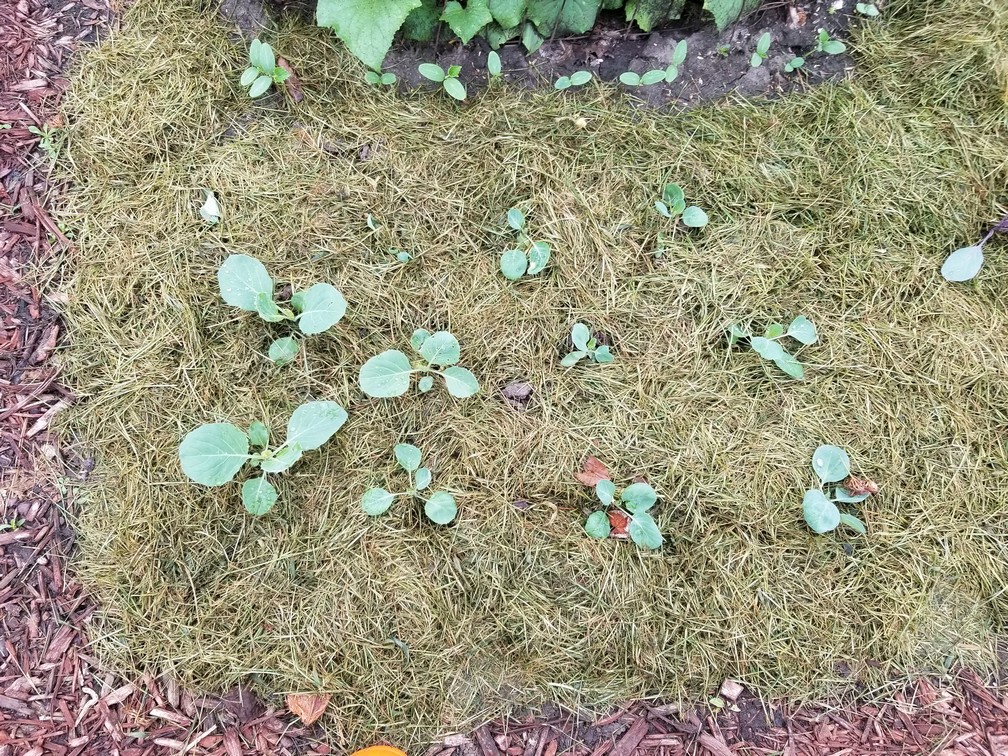
I crammed a bunch of cabbages in a relatively small area, so when I inevitably lose some to rabbits, cutworms and cabbage moth caterpillars, I might end up with a few edible heads.

'Primo Vantage' cabbage seedlings

'Omero' purple  cabbage seedlings

The rhubarb is coming back.  With the exception of the two newest - and most favored because they had redder stems - that is.  I do hope those aren't dead.


The toadstools were happy with the flooding.

I'm bummed about the tomatoes.  I managed to mislabel my seedlings, and ended up with only two 'German Johnson' plants and six 'Yellow Pear' cherry tomato plants.  I didn't think I even had that many of the cherry tomatoes.  I was aiming for one, and seven 'German Johnson' plants.

I planted the one I thought was a 'Yellow Pear'  against a trellis.  And that turned out to be one of the GJs, which would do much, much better in a cage.   Rats!

'German Johnson'

'Yellow Pear'

The cucumbers, which I thought might die from all the rain, managed very well and are climbing up the back of my wagon wheel.  The four o-clocks in the front are not what I was expecting.  Perhaps I don't remember what four o-clocks do, but I didn't expect the flowers to have such long tubes.  And then again, maybe they don't in normal rainfall years.


The 'Cardinal' basil is looking pretty at last, with its bright green leaves and dark red stems.


The Charentais melons are climbing up their cages and over the marigolds.  Fingers crossed, because last year was so bad for cucurbits that I didn't get even one melon.


My cousin recently told me about an app that helps you identify anything you frame in your phone's camera lens.  I found Google Lens to do that, and have finally, after seven years, been able to identify a flowering plant as toadflax, and name two troublesome weeds that plague the garden...

'Green carpetweed'

'Prostrate spurge'

The spurge is one I had known in California from my weed science courses, but I couldn't recall the name.  It reminded me of puncture vine, but I knew it wasn't that because it has no thorns.  Thankfully.  I'm eager to find out next spring what the ground-covering weed is that has the teeny tiny blue flowers, which I think may be bird's-eye speedwell.

Another weed that's trying to take over is purslane.  I've been battling this one ever since I started gardening.  When you try to remove it, it easily breaks apart, and each part roots itself with ease.

'Purslane'

One year I let it go, because it's edible.  I didn't much care for it though.

But....the Stargazers are in full bloom, and it smells heavenly right here...


' Til next time.